
Integrated Protein Production: Where Program Time Actually Goes
Integrated protein production moved up the buyer agenda this fall. On October 12, 2026, Research and Markets projected that the contract manufacturing and research services market will grow from $303.8 billion in 2026 to $472.1 billion by 2033. That summary credits integrated services with shorter timelines. Consequently, sponsors are looking harder at their own workflows.
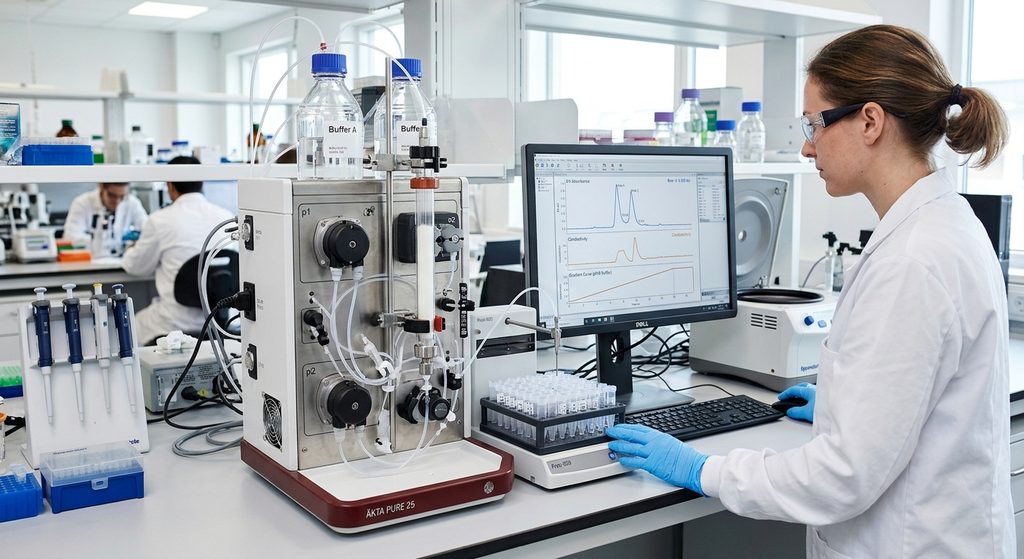
Why Integrated Protein Production Shortens Timelines
Calendar time rarely disappears at the bench. Instead, it collects at the seams between steps. Each transition restarts something, whether assay qualification, clone re-screening, or fresh identity testing. Therefore the number of transitions matters as much as the pace of any single stage.
Consider the usual sequence. First comes construct design and gene synthesis. Next come transfection, drug selection, and single-cell cloning. Then screening, banking, expansion, production, and purification follow in turn. Every stage produces data the next stage relies on, so record continuity carries real scientific weight.
What Integrated Protein Production Requires Scientifically
Baselines make integration worthwhile. A master cell bank drawn early anchors every later comparison, because expression and growth characteristics drift as passage number climbs. ICH Q5D frames expectations for characterizing cell substrates, and your quality team can confirm specifics there.
Measured endpoints then travel with the line. Genetic stability, expression level, growth rate, and sterility results belong in one record set. Additionally, purification development moves faster when the same group already knows how a clone behaves in culture.
Spent media data illustrates the point. Glucose, lactate, and ammonium trends recorded during expansion inform feed decisions at production scale. However, they only pay off when the production team can see them directly.
Evaluating a Partner on Integrated Protein Production
Continuity is the criterion worth testing. Ask a prospective partner where the handoffs sit, and ask which tests repeat at each one. Clear answers signal a well-mapped process. Cell Culture Company has run mammalian and insect cell culture from a single Shoreview, Minnesota facility since 1983. As a result, one US-based team carries a program from gene sequence through cell line development, culture expansion, protein production, and purification.
Scale range deserves equal weight. We expand shaker flasks to 10 L, suspension cultures from 10 to 200 L, and adherent cultures to 75,000 cm² per batch. Purification runs from analytical through preparative scale. A program can therefore move up or down without changing vendors. Meanwhile, weekly progress reports and direct contact with the scientists at the bench keep decisions close to the data.
Frequently Asked Questions
What does integrated protein production include?
It spans gene sequence through purified protein under one ISO 9001:2015 quality system. Specifically, that covers cell line development, banking, expansion, production, and purification.
Does an integrated workflow limit batch size?
No. Our work ranges from bench-scale feasibility to repeat production batches. Additionally, the same team and the same records follow a program as volumes change.